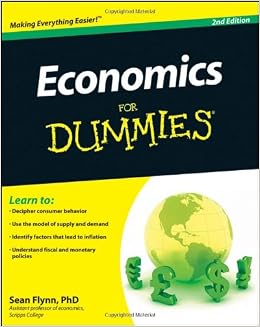
В универе у нас было два (а может быть все четыре - не помню) семестра по экономике. Мы даже писали рефераты старательно выписывая параграфы из одного и старых изданий Экономикса. Но знания я вынес исключительно пассивные: есть микро и макроэкономики, спрос/предложение и куча других терминов - лежащие мертвым грузом, ни объяснить ни использовать их я никак не мог. Кстати интересно было читать книгу и вспоминать/угадывать русский перевод терминов которые еще остались в голове спустя 10 лет.
Последней каплей стало превращение в юридическое лицо, внешнеэкономическая деятельность. Необходимость самостоятельно платить налоги действует очень отрезвляюще по сравнению с получением смски о пришедшей зарплате - хотя фактически я так и остался наемным работником. Срочно нужно было подтянуть матчасть.
 На работе периодически нам периодически закупают книги, третий закуп был для общего развития и заказывать книги нужно было не относящиеся к программированию. Я по приколу решил заказать Экономику для чайников и не ошибся: такая книга действительно была и даже выдержала переиздание. Внезапно, ожидания не оправдались и вместо легкого и непринужденного чтива перед сном книга оказалась офигительнейшим учебником по микро- и макроэкономике. 10 из 10, чистейший мастрид, такую крутую книгу не держал уже несколько лет в руках.

Все формулы в книге крайне просты даже для школьника младших классов. Весь раздел микроэкономики крутится вокруг двух графиков: спрос/предложение и маржинальный доход (удивлен кстати что ни разу не упомянута критическая цепь). Макроэкономических раздел посвящен рецессиям и весьма не богатым механизмам борьбы с ними. Laissez faire и Кенессианская модель роли государства. Последний раздел 10 заблуждений, 10 полезных вещей и 10 интересных вещей вообще самодостаточен.
Дальше пол дюжины интересных цитат из первого раздела
Необходимые требования для экономического роста:
So what factors combined in the late 18th century to so radically accelerate economic growth? The short answer is that the following institutions were in place
Democracy...
The limited liability corporation...
Patent rights to protect inventors...
Widespread literacy and education...
Про возможности...
Limited resources: The first factor is obvious. If resources were unlimited, goods and services would be as well.
Diminishing returns: Basically, diminishing returns means that the more you make of something, the more expensive it becomes to produce. Even with mass production, after some level of output the cost of producing additional units will begin to rise. Eventually, the increasing cost exceeds the benefit of producing additional units. That of course limits how much of the product in question you will want to produce, even if it’s your favorite thing. In such situations, resources should be reallocated to producing units of other products for which the benefits still outweigh the costs.
... и ресурсы производства
Land: Land isn’t just real estate but all naturally occurring resources that can be used to produce things people want to consume. Land includes the weather, plant and animal life, geothermal energy, and the electromagnetic spectrum.
Labor: Labor is the work that people must do in order to produce things. A tree doesn’t become a house without human intervention.
Capital: Capital is human-made machines, tools, and structures that aren’t directly consumed but are used to produce other things that people do directly consume. For instance, a car that you drive for pleasure is a consumption good, but an identical car that you use to haul around bricks for your construction business is capital. Capital includes factories, roads, sewers, electrical grids, the Internet, and so on.
In addition to these three traditional inputs, economists now often speak of human capital, which is the knowledge and skills that people use to help them produce output. For instance, I have a lot of human capital with regard to teaching economics, but I have extremely low human capital with regard to painting and singing.
Про туалетную бумагу и плановую экономику
In a command economy, all economic activity is done on the orders of the government. Until the fall of the Berlin Wall and the subsequent collapse of communism in the late 1980s and early 1990s, a large part of the world’s population lived in countries that had command economies. Sadly, they didn’t live very well.
Shortages of everything from sugar to clothing to toilet paper were constant. More seriously, doctors often lacked hypodermic needles and medicines for their patients, and food was often in short supply.
Goods and services weren’t allocated using a price system whereby output went to those willing and able to pay for it. Rather, because everyone in a communist country is ideologically equal, the government attempted to give everyone an equal share of the goods and services made. The result, though, wasn’t an equal division; instead, there were long lines, with those able to stand in line the longest getting more than their fair share. The lines were so long that people often stood in line for an entire day just to get one roll of toilet paper. If you saw a line forming, you got in it as fast as you could, even if you didn’t know what people were standing in line for. Because everything was in short supply, it was almost certainly something you’d want.
What caused this mess? Centralization. In Moscow, government officials called central planners attempted to determine the correct amounts to produce for 24 million different items. It was an impossible task! To see why, consider toilet paper. First, you estimate how many millions of rolls of toilet paper are needed. Then you have to figure out how many trees to cut down to make that much paper and how many railcars you need to carry those trees to paper mills and how many workers it takes to run those mills. At the same time, you have to try to balance the production of toilet paper against the other zillion things that also require trees, railcars, and workers.
The entire problem is far too complex and requires far too much information to be solved. The result was that resources were constantly being misdirected and wasted. For instance, food often rotted at farms because no railcars had been scheduled to take it to cities; the officials hadn’t accounted for an early harvest, and the railcars were busy elsewhere. In a price system, the farmers would have simply paid to bid the railcars away from other uses. This solution wasn’t possible in a centralized economy in which prices weren’t used to allocate resources.
Про помощь третьему миру...
A perverse result of agricultural price supports in rich countries like the United States and the nations of the European Union is the great damage they inflict on developing nations. For instance, the U.S. price of sugar is substantially higher than the world price because the United States restricts imports of cheaper foreign sugar in order to help U.S. food production giants sell corn-based sweeteners. The result is that thousands of poor Third World farmers who could otherwise make a living selling sugar to Americans and Europeans are left without a livelihood.
Even worse is what the United States does with some of the many tons of excess agricultural products that pile up due to its agricultural price supports. Not wanting to sell the excess in the United States and thereby depress U.S. prices, the government often sends the stuff free to developing countries as food aid. That sounds nice and friendly, but when all that free wheat hits Nigeria, it puts Nigerian farmers out of business. That in turn ends up making Nigeria dependent on foreign food because it no longer has enough local farmers to produce sufficient quantities of wheat to feed its own people.
Even worse, many of the newly bankrupted farmers move from the countryside to cities in search of employment, worsening urban-overcrowding problems and themselves becoming dependent on free foreign wheat to survive when most of them can’t find employment. Thus, the U.S. government’s attempt to make its relatively very wealthy farmers even a bit richer ends up causing catastrophic harm to the truly very poor farmers of developing nations.
To avoid these problems, economists recommend that food aid from rich countries only be sent to poor countries during times of famine or drought when local farmers are unable to produce enough to feed their country. Food aid should be withdrawn as soon as a crisis ends so that it doesn’t permanently undercut local food prices and the ability of local farmers to make a living.
... и производителей молока
Price supports generate huge piles of surplus crops that nobody wants to buy. For instance, thanks to supporting the price of milk, each year the U.S. government must buy up hundreds of thousands of gallons of milk that nobody wants to buy at the high price the government is maintaining to help dairy farmers. What does the government do with the milk? It turns it into cheese that it can’t sell (because it’s also supporting the price of cheese) and stores the cheese in huge refrigerated warehouses — indefinitely! And yes, this is all done at the taxpayer’s expense.
Because many people have protested this sort of wastefulness, the government switched policies for some crops. The government now pays many farmers not to farm. That way, the farmers still get paid, but there’s no worry about an excess supply that has to be destroyed or given away.
Все больше не буду, книга великолепна, читайте всё, это того стоит.
